
What is the one-time buyer problem and why should you solve it?
There are two types of customers in your database: one-time buyers and repeat buyers. In most online shops, especially those that do little CRM, one-time buyers make up between 70 and 80% of the customer base.
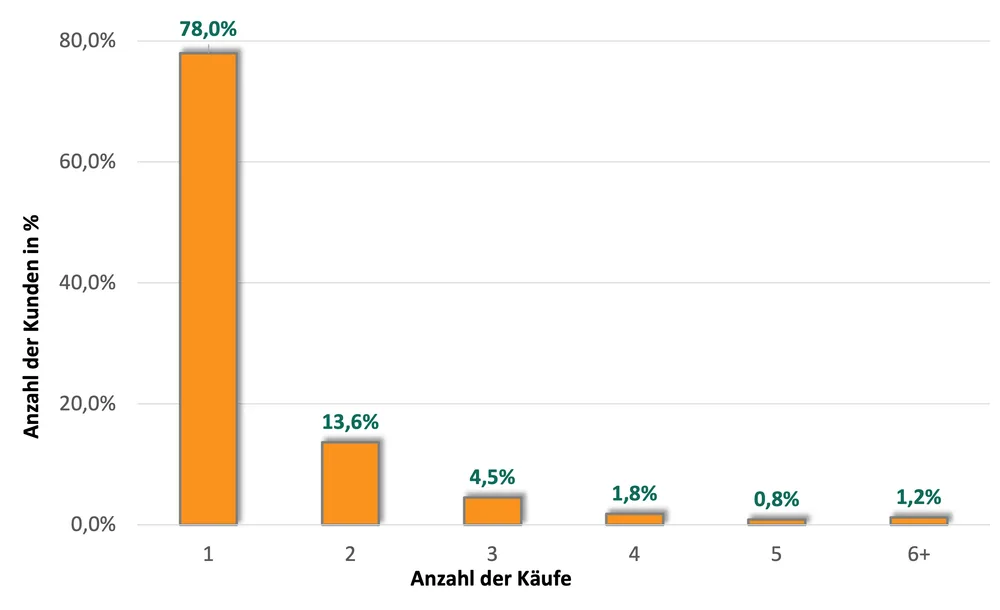
These one-time buyers are an enormous growth opportunity and the biggest lever for increasing profitability. You can find a sample calculation at the end of this article. The reasons include:
A) Higher conversion rates: unlike new customers, one-time buyers have already bought and tested your product. Assuming customers were satisfied with the result, this is a major step toward a repeat purchase. For a repeat purchase, you now “only” need to address the customer at the right time with the right offer, instead of leaving it to the customer to start searching again when the need arises. While new customers usually have a conversion rate between 2% and 4%, well-executed second-buyer and reactivation campaigns typically convert at 5% to more than 10%.
B) Significantly lower marketing costs: online marketing costs, especially on Google and Meta, have been rising continuously for years. In most industries, profitable new-customer campaigns are becoming increasingly rare. Reactivating existing customers, by contrast, is around 5 to 7 times cheaper. In addition, you already have direct contact with these customers and are not dependent on the major platforms and their algorithms.
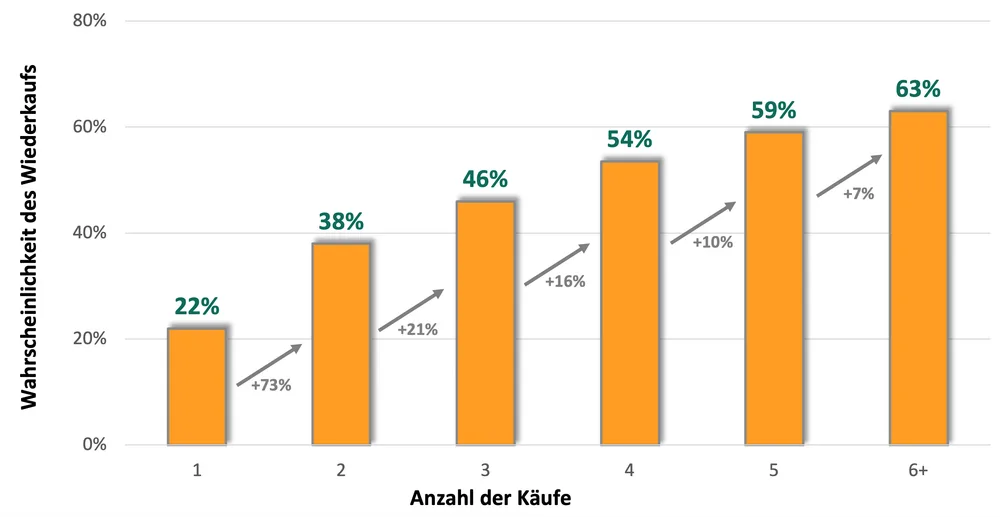
C) Higher repeat-purchase probability with every additional purchase: with every further purchase a customer makes with you, the probability rises that they will buy from you again. The customer builds an emotional connection with you and the barriers to convincing them to make the next purchase decrease. As a result, customer lifetime value increases disproportionately. The second purchase is the key moment. This is where the probability of a third and further purchases rises the most.
Sample calculation for growth potential when second buyers increase by 10%
The easiest way to show the importance of the one-time buyer problem is with an example. Assume you have 100,000 customers in your shop. For simplicity, your average basket value is €100. The distribution of your customers by number of purchases follows the average values above. That means you currently have 78,000 customers who have bought from you only once.
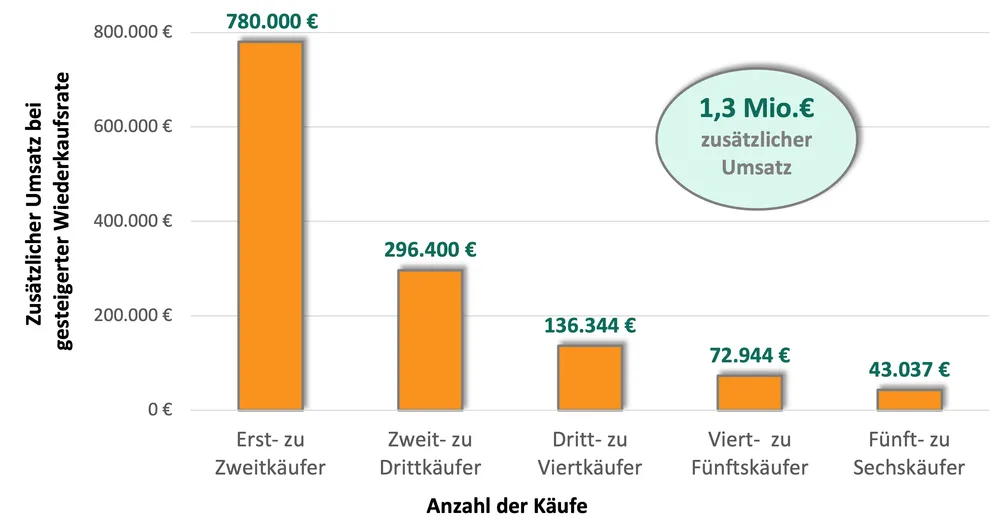
If you now manage to move just 10% of these one-time buyers to a repeat purchase through your CRM and second-buyer campaigns, meaning 7,800 customers, you have generated an additional €780,000 in revenue. These additional 7,800 customers will now make further purchases, so that across the full customer lifetime, a total of €1.3 million in additional revenue can be recorded.
Now that we understand the one-time buyer problem, the natural question is how to solve it. For this, we have written a complete guide as well as further articles that go significantly deeper into the topic.
Guide: turn first-time buyers into second-time buyers and solve your one-time buyer problem
Master the second-purchase campaign: the key to customer retention in online retail
How-to: find the right timing for your repeat-purchase campaign