
You have decided to solve your one-time buyer problem and consistently turn customers into repeat buyers? You have already thought through a suitable second-purchase campaign and can hardly wait to see the results? One question remains: when should you send the campaign? Too early, and customers feel annoyed and the effect fizzles out. Too late, and customers have almost forgotten their purchase experience with you and are only marginally activated. This article addresses that question.
Analyze the purchase behavior of your repeat buyers
First, look at all your repeat buyers and check how many days passed between the first and second purchase. Then sort your customers in ascending order, with the shortest period between purchases first and the longest period at the end. Now determine the median and the 75th percentile to find out when 50% of your customers, the median, and 75% of your customers, the 75th percentile, have already purchased again. These two points in time are excellent for your second-purchase campaigns.
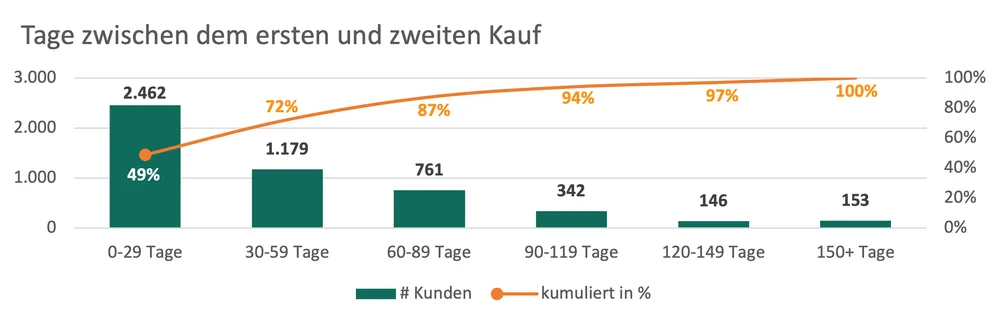
Comparing your second-purchase campaigns
The most important second-purchase campaign is the one after the 75th percentile, because this is when customers begin to become inactive. You should absolutely avoid that. It is many times harder to reactivate an inactive customer than to keep an active customer. Use a larger incentive, for example a 15% or 20% voucher, to motivate customers to buy again. Especially for consumable products, such as cosmetics or supplements, this is also the ideal moment to remind customers to restock. The focus of this campaign is therefore to retain your customers.
By contrast, the second second-purchase campaign focuses on convincing customers of additional products or offers. For this, you should orient yourself around the median between first and second purchase. At this point, the customer has had enough time to test your product and form an opinion. If satisfied, they are open to further offers from you. Complementary products to the first purchase make sense here, such as matching clothing items or additional supplements. If you have a limited product range, offering a subscription or membership in your loyalty program can be attractive.
If you do not have a suitable offer, however, it is best to focus on the campaign after the 75th percentile. Still, try to create another offer soon so you can enable more touchpoints with your customers.
Frequently asked question: why do we not wait until 100% of customers have purchased again? I do not want to spend money on customers who would have bought again anyway.
Your biggest lever for revenue and profitability growth is converting as many first-time buyers as possible into second-time buyers. For this, it is generally better to address customers while they are still active and while the last purchase was not too long ago. It is impossible to completely avoid addressing customers who would have purchased again anyway. But the overall benefit of addressing customers who would not have bought again is significantly higher.
Here is an example, using average repeat-purchase behavior values for e-commerce customers. You can read all values and how they are derived in our article on the one-time buyer problem.
We again assume 100,000 customers, of whom 78,000 buy only once. We estimate that around 10% of them can be moved to a repeat purchase with a 10% voucher. That gives us 7,800 additional second-buyer orders. With an average basket value of €100, this equals €780,000 in gross revenue. After deducting voucher costs, €702,000 in additional revenue remains.
We send the campaign after the median time period for a repeat purchase, meaning we also address half of the customers who would have purchased again anyway, 11,000 customers. These customers now order with the 10% voucher and create €110,000 in voucher costs that we would not have had without the campaign.
After deducting voucher costs, our second-purchase campaign has therefore generated an additional €592,000 in revenue and 7,800 new second-time buyers. These second-time buyers are now also more likely to make further purchases, which means another €550,000 in revenue can be expected over the full customer lifetime. In total, €1,142,000 in revenue stands against additional voucher costs of €110,000.