
BRAINEFFECT, one of Germany’s leading supplement brands for body and mind, has built a strong position in a highly competitive market. The first purchase is usually not profitable, so keeping as many customers active as possible is critical.
For that reason, BRAINEFFECT regularly runs campaigns for new and existing customers to generate high reach and awareness, including influencer collaborations and email marketing. However, the company noticed that a substantial share of one-time buyers regularly could not be activated. BRAINEFFECT wanted to understand why.
In this case study, we show how BRAINEFFECT used PostPal postcards to reach even the “unreachable” customers, generate more than 470% ROAS with little effort and turn lost one-time buyers into repeat buyers.
The problem: many customers are already lost
As with many DTC supplement brands, most of BRAINEFFECT’s customer base consists of one-time buyers who become inactive after their first purchase and are difficult to reach. These customers rarely read the newsletters, if at all. BRAINEFFECT offers are simply not noticed, which makes effective reactivation difficult. Other marketing channels such as retargeting also rarely produce the desired effect for these customers.
BRAINEFFECT suspected that unused potential was still hidden in this customer base. The team therefore set up a reactivation campaign with PostPal to identify the dormant potential in contacts they had believed were lost.
The campaign
Because BRAINEFFECT regularly runs large campaigns and communicates with all customers, the reactivation segment was defined as customers who could not be activated through several email campaigns.
The postcards were sent to customers who had not purchased for between 9 and 12 months. Even especially attractive Black Friday, Christmas or New Year’s resolution offers had not reached these customers. Around 85% of them were one-time buyers.
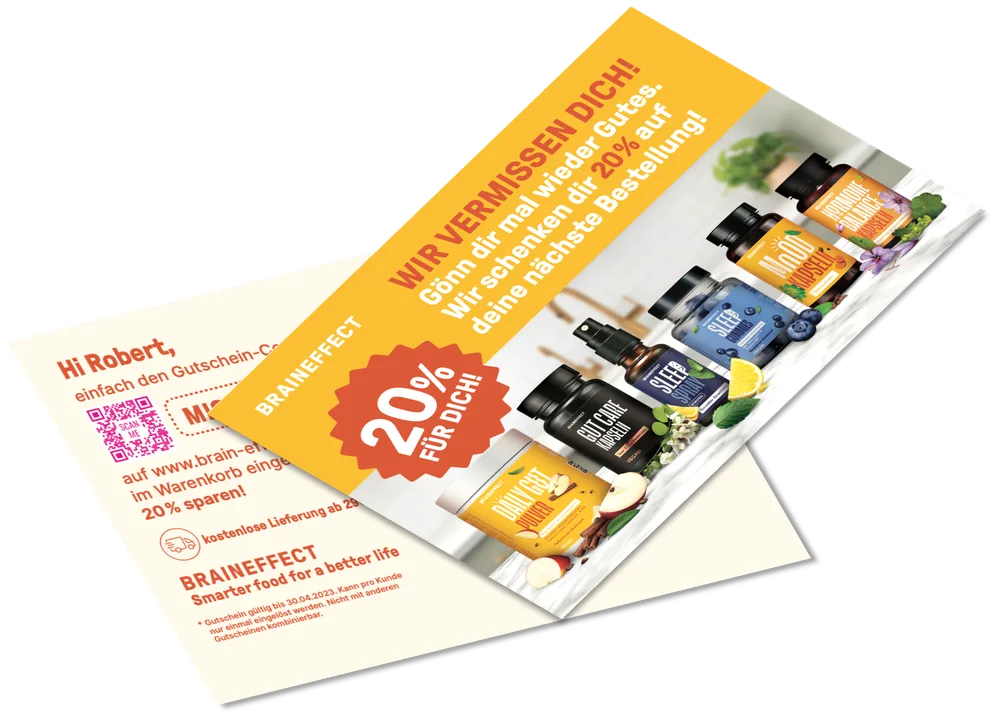
To achieve maximum activation, the postcard design was built to reflect the breadth of the company’s product range and offered an attractive 20% discount with an individual voucher code. Customers were also addressed personally in the copy to quickly reduce distance. To increase urgency, the voucher code was time-limited.
The results
The results were excellent. In total, 3.1% of contacted customers purchased again during the observation period, which produced a ROAS of 470%. Two thirds of buyers redeemed their voucher. The remaining third was activated without redeeming a voucher, further increasing the campaign’s profitability.
Looking at when vouchers were redeemed shows another strength of the campaign: the longevity of postcards. 50% of vouchers were redeemed within the first 12 days. The remaining 50% were distributed evenly across the following 40 days. This meant BRAINEFFECT stayed in customers’ field of vision and awareness much longer than would have been possible with online marketing.
The campaign also had a positive effect on average basket size. On average, customers ordered 15% more products per purchase than normal repeat buyers.
The campaign shows how effective postcards are for reaching customers who are already considered lost on other channels. Even so, it is better not to let customers become inactive in the first place. That is exactly what BRAINEFFECT is planning for its next campaign. As soon as the team sees that an existing customer has stopped responding to emails and has become inactive, those customers should be kept active with postcards. With PostPal, this approach can be automated with little effort.