
TL;DR
RFM segments your customers by recency, when they last purchased, frequency, how often they purchased, and monetary value, how much they spent. No score, no magic. But it is the most accurate behavioral picture you have. In most DTC shops, 60 to 80% of customers are one-time buyers. Reducing that share is the strongest lever for increasing CLV: 5 percentage points more second-time buyers increase your average CLV more than almost any other measure.
The LTV of a second-time buyer is twice as high as that of a one-time buyer. And people who buy twice often also buy a third, fourth and tenth time. Five segments, five strategies: from VIP campaign to winback. RFM shows you where each customer stands and what makes sense next. PostPal calculates your RFM segmentation automatically from your Shopify order data. You see at a glance how large each segment is and can derive your next campaign directly from it.
The problem: you address all customers the same way
Most DTC brands know two types of customers: buyers and non-buyers. Someone who has ordered once goes into the newsletter. Someone who has never ordered receives ads. Done.
The problem: this logic ignores everything that happens after the first purchase. Or does not happen.
Active customers need inspiration, not a discount
If you send the same voucher to every customer on your list, you give away margin to customers who would have bought anyway. A customer who ordered in the last 30 days and regularly comes back will buy again. What this customer needs is not a 15% code, but a hint at what they should not miss next.
Worse: if customers know the next sale is coming, they do not buy at full price. You condition your best customers to expect discounts. We described how to work with tiered incentives instead, without burning margin, in our guide to discount ladders.
You reach inactive customers too late or not at all
On the other side are customers who have not ordered for 200 days. They receive the same campaign as last week’s active customer. Or they land in spam because their open rate is close to zero.
And then there are customers you cannot reach by email at all: people who never subscribed, unsubscribed or never opened. They exist in your order history, but are invisible in your marketing stack.
The reactivation window is not open indefinitely. The longer it has been since the last purchase, the more expensive winback becomes. RFM solves both problems through structure.
What is RFM segmentation?
RFM stands for recency, frequency and monetary value. Three dimensions that together create an accurate picture of purchase behavior.
Recency: how long ago was the last purchase? A customer who ordered 10 days ago is significantly more responsive than one who has been inactive for 300 days.
Frequency: how often has this customer purchased? For most e-commerce brands, this is the strongest indicator. The minimum: distinguish between one-time buyers and repeat buyers. These two groups differ fundamentally in their probability of buying again and in the strategy you need to activate them.
Monetary: how much has this customer spent? Combined with frequency, this gives you CLV. For brands with low AOV, it often makes sense to initially exclude customers below a threshold. This increases the ROAS of your mailings and lets you gradually find the threshold at which reactivation becomes profitable.
The model is not new. It comes from direct marketing in the 1990s and has established itself in DTC e-commerce as the leading retention framework. AI-based segmentation models are conceptually interesting, but most brands do not yet have the statistical basis to achieve truly better results there. RFM creates a system that does not keep you busy 24/7 and still works consistently.
RFM segmentation is not a static profile. A customer who is “Active” today can be “At Risk of Churn” in three months if they do not purchase again. The framework forces you to see customer status as a moving picture, not a fixed state.
The five segments and what they tell you
The RFM model can become arbitrarily complex. In practice, that is often the mistake: with too many segments, you quickly lose overview and therefore the ability to act. PostPal therefore uses a simplified model: five segments based on the recency dimension, calibrated specifically for each shop.
Here is an example from a real DTC shop with almost 400,000 customers:
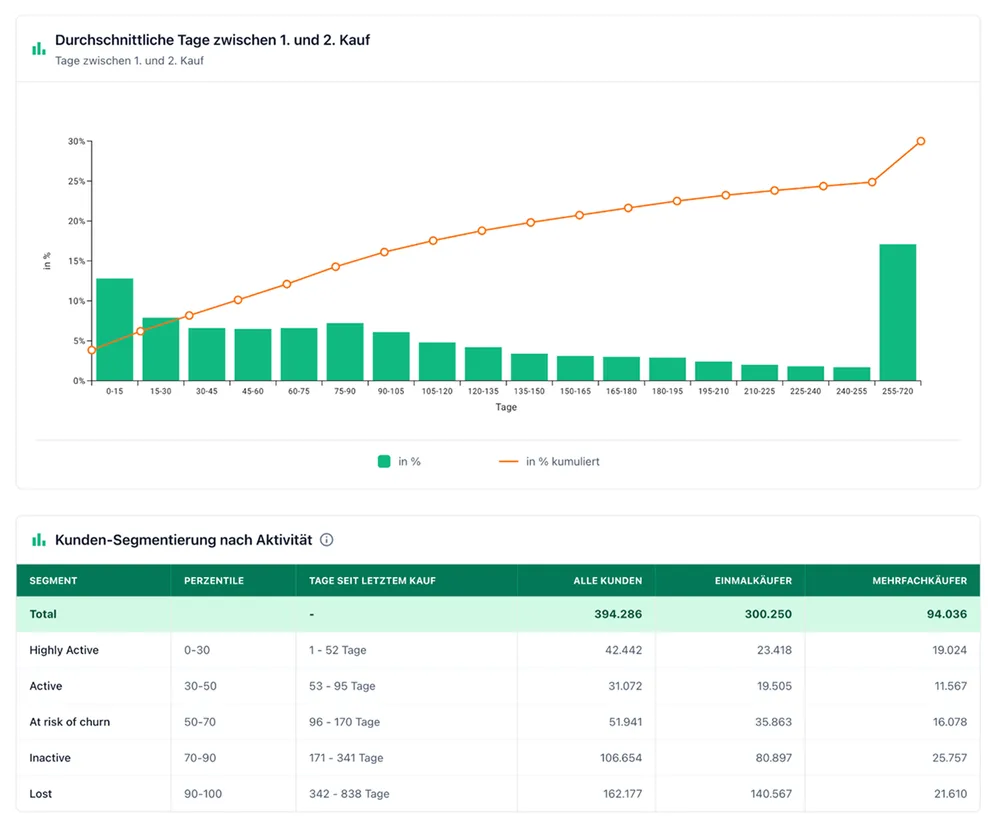
First: how the share of one-time buyers is distributed in each segment says more than the overall value. The goal is not 0% one-time buyers. The question is: how many can you move to the next purchase level? Some brands with an 80% one-time-buyer share are excellently positioned; in other industries, 60% is average. What matters is your development over time and at cohort level: do your one-time buyers become second-time buyers faster year after year?
Second: inactive and lost together make up 270,000 customers, 69% of the total base. The older a brand becomes, the more lost customers accumulate. That is not a bad number. It is unused potential. These customers bought once, you know their address and their behavior. A systematic reactivation strategy turns this part of the customer base back into value creation.
Which campaign for which segment?
Highly Active + Active, repeat buyers: VIP campaign
These customers buy. They do not need a discount to come back. A postcard with exclusive early access, a product highlight or a personalized thank-you strengthens the bond without giving away margin.
Active, one-time buyers: second-buyer push
The strategically most important segment. Purchase willingness has been proven, interest is still fresh. Email campaigns often perform weakly here because the customer is not yet loyal enough to actively open the inbox. A physical postcard at the right moment pulls the customer out of the noise.
Important when evaluating: do not look only at campaign ROAS. In many shops, a one-time buyer who becomes a second-time buyer buys a third and fourth time. The actual ROI is significantly higher than the direct campaign return shows.
At Risk of Churn + Inactive: winback
Purchase interest existed, but the window is closing. These customers are often no longer actively reachable in the email system, but they are reachable through direct mail. Winback campaigns are usually the best starting point for brands that do not yet use print: clearly defined target audience, proven purchase behavior, and you reach customers who are long lost to digital channels.
The longer you wait, the more expensive it becomes. Contacting early is always cheaper than letting the segment slide further down.
Lost: dedicated reactivation campaign
Lost customers purchased at some point. You know their address, and you know what they ordered. That is an advantage over every cold Meta audience, where you start with zero information and pay CPMs.
Lost customers need a strong offer. A normal 10% voucher will not be enough. An exclusive comeback offer or a personalized occasion can work. The conversion rate will be lower than with inactive customers, but with the right segmentation, ROAS is positive.
The biggest lever is the first repeat purchase
The jump from first to second purchase is not linear. It is exponential.
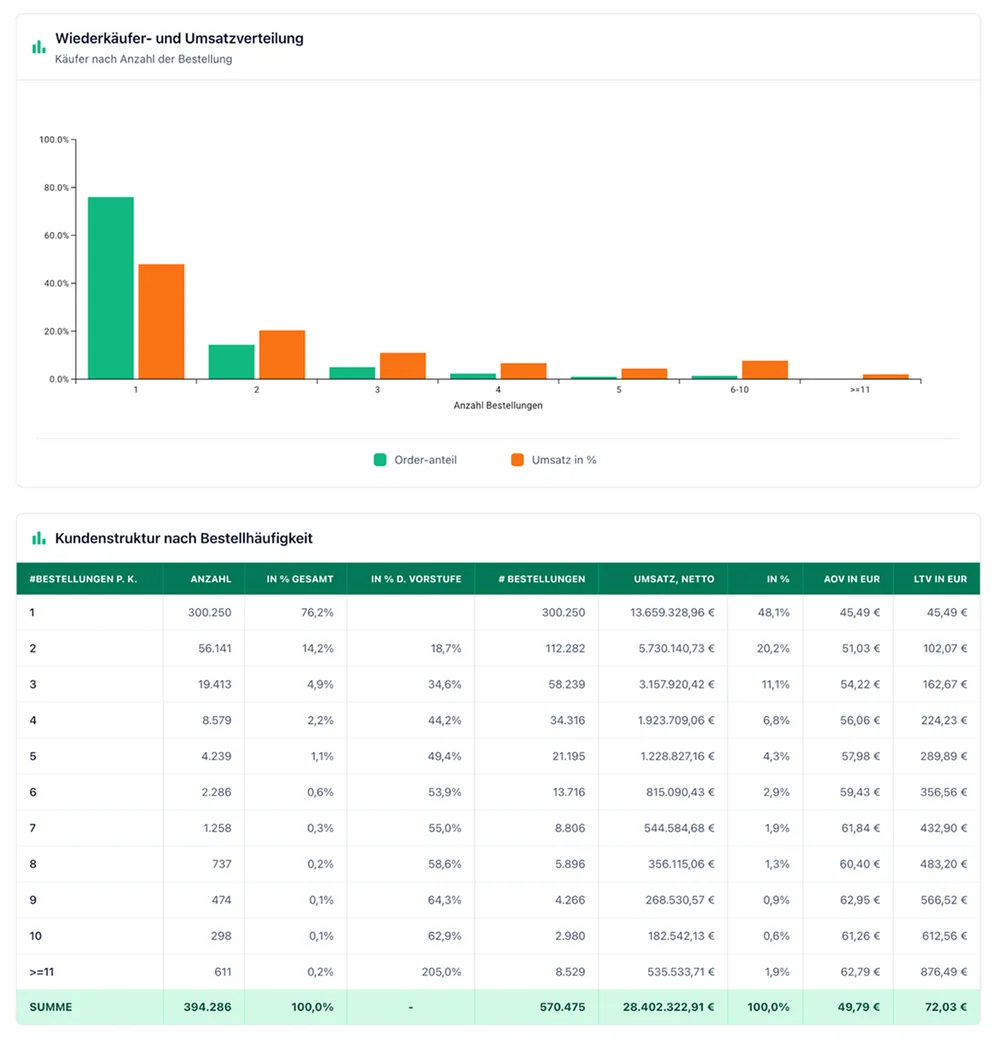
A second-time buyer is 2.2 times as valuable as a one-time buyer. But the decisive effect runs deeper: in shops with healthy repeat-purchase behavior, the probability of further purchases rises with every order. The customer knows the brand, has built a preference and is invested. Someone who becomes a second-time buyer often does not remain merely a second-time buyer, but buys a third, fourth and tenth time. The first repeat purchase is therefore not only a CLV lever. It is the entry point into a purchase habit.
Timing is decisive. The purchase-rhythm chart in the RFM report shows you when most customers make their second purchase. In most DTC shops, the window is narrower than expected. If you know it, you can align the second-buyer push exactly to it, not to an arbitrary time period.
The RFM report in PostPal
PostPal calculates all five segments automatically from your Shopify order data. You see at a glance how your customer base is distributed: segment size, one-time and repeat buyers per segment, LTV distribution and average purchase rhythm.
What you do with it: select segment, derive timing from the purchase-rhythm chart, set up campaign. No assumptions, directly from your own data.
The report is currently available for Shopify shops.
FAQ
What is RFM segmentation?
RFM stands for recency, frequency and monetary value. It segments customers by their actual purchase behavior: when they last purchased, how often and how much. The result is segments that show where each customer stands in the customer journey.
How much more valuable is a second-time buyer compared with a one-time buyer?
About twice as valuable. In a typical DTC shop, LTV rises by around 100% from the first to the second purchase. In addition, repeat-purchase probability rises disproportionately with every further order.
Which customer segments are suitable for direct mail?
Active one-time buyers (second-buyer push), At Risk of Churn and Inactive (winback), as well as Lost customers with a strong offer (reactivation). Highly Active and Active repeat buyers are suitable for VIP campaigns.
What does “At risk of churn” mean?
Customers who purchased relatively recently but are slowly drifting out of the active window. They are still reachable, but the probability that they come back on their own is falling. That is the moment to become active.
When is a reactivation campaign for Lost customers worthwhile?
When the expected LTV after reactivation exceeds the campaign costs. Lost customers need a stronger offer than inactive customers, but ROAS remains positive because you are working with real purchase data instead of a cold audience.
Conclusion
RFM segmentation is the basis for running retention not by gut feeling, but by behavior. You know where your customers stand, when the reactivation window closes and which campaign makes sense for which segment.
Look at your RFM report in your PostPal account. Which segment is largest for you? Start there.